How to Meet the Delaware LLC Publication Requirement (2026)
By How to Meet the Delaware LLC Publication Requirement (2026)
17 Min Read

Delaware has no LLC publication requirement. Not a reduced one, not a waived one: none. If you're mid-search convinced you owe a newspaper something, stop. You don't.
Delaware has no LLC publication requirement. Zero. Not a reduced one, not a waived one, none.
The common assumption is that every state has a publication requirement for LLCs, so Delaware must have one too, and the filer just hasn't found the right instructions yet. That assumption is wrong, and it should end the search for most filers, yet the question keeps surfacing because the information ecosystem around LLC formation is genuinely broken. If you landed here mid-panic, already convinced you owe a newspaper something, you can stop that particular errand right now.

See our public notice for how this works in practice. Delaware does not require LLCs to publish a notice in any newspaper at any point during formation. Delaware Limited Liability Company Act, Title 6, Chapter 18, Section 18-201 contains no publication step anywhere in Subchapter II, the section that governs formation entirely.
The statute is unambiguous: formation is complete the moment the Certificate of Formation is filed with the Delaware Division of Corporations. Nothing follows. No notice. No newspaper. No waiting period. Section 18-201(c) goes further, stating explicitly that filing the certificate "shall make it unnecessary to file any other documents" under the relevant chapter. Delaware's General Assembly did not forget to add a publication step. It built a formation statute that requires nothing beyond the initial filing, and formation is complete at filing. That is the statute's actual position.
The false belief has a clear origin: high-volume publication states bleed into Delaware searches. New York's LLC publication requirement is one of the most expensive formation obligations in the country, with filers in some counties facing steep costs, ranging as high as $1,795 depending on the county, to run notices in two newspapers for six consecutive weeks. Arizona and Nebraska carry similar mandates. Formation guides written for those states rank well in search engines, and their language reaches filers who typed "Delaware LLC publication requirement" and assumed the answer would be the same.
Generic formation services compound the problem. Automated checklists built for multi-state use sometimes include a publication line item regardless of state, sending filers on a compliance errand that Delaware law never assigned them.
$1,795
Max New York LLC publication cost
If your LLC was formed in Delaware but operates in a state that does require publication, that state's rules apply to you regardless of where you filed. Delaware's silence on publication is unambiguous. But that silence only protects you if Delaware is the only state whose rules apply to your situation. The next section maps exactly which states do impose a publication requirement, so you can confirm whether you are genuinely off the hook or whether a second set of rules is quietly waiting for you.
Key takeaways
Delaware has no LLC publication requirement, not a reduced one, not a waived one, none. Most filers waste hours searching for instructions that don't exist.
Only three states impose a genuine LLC newspaper notice requirement. Every other state, including Delaware, does not.
Delaware's LLC formation checklist is five steps. The brevity is intentional, the state has processed hundreds of thousands of new entities annually without a publication step bolted on.
The Certificate of Formation that legally creates your Delaware LLC is shorter than most restaurant menus, and that's by statutory design, not oversight.
Delaware skips an annual report entirely. The one ongoing obligation is a flat annual franchise tax, missing it carries real penalties, so the silence around it is its own risk.
Forming in Delaware doesn't close every compliance door. If you operate in New York, Arizona, or Nebraska, those states' publication requirements apply to your foreign qualification, Delaware's clean process doesn't travel across state lines.
Column's Self-Serve Portal closes the gap for filers who do need to publish: choose any newspaper in the United States, enter your details, build the notice, schedule it, pay, and receive the affidavit digitally, no account creation, no classifieds desk, no quote to chase.
Which States Actually Require LLC Publication (So You Know If You're Off the Hook)
Three states impose a genuine LLC newspaper notice requirement. Every other state, including Delaware, does not. That gap matters more than most founders realize. Filers who have heard the term 'publication requirement' in another context, a prior state filing, a colleague's experience in New York, or a generic formation checklist, often carry that expectation into a Delaware filing without checking whether it applies. The confusion is understandable; it comes from a reasonable but inaccurate assumption that the rule is universal.
1. New York - The Most Expensive and Burdensome Publication State
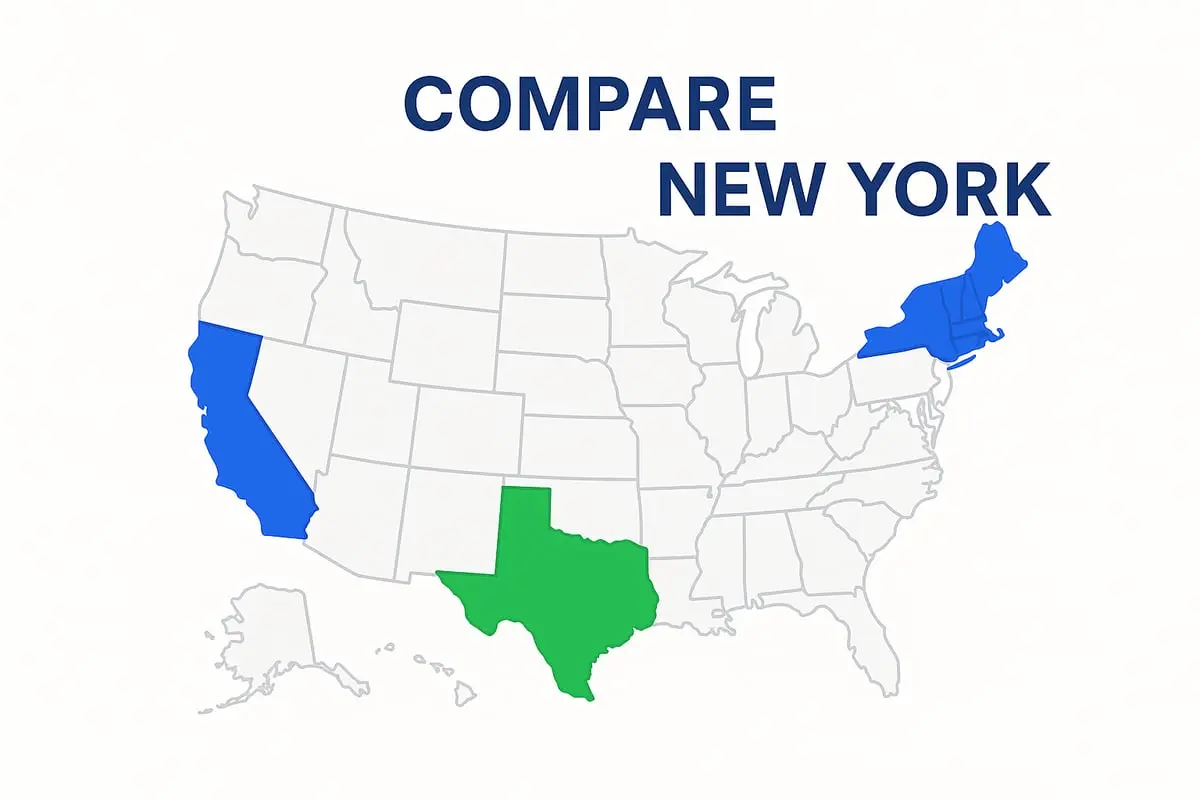
New York requires every new LLC to publish notice of formation in two county-designated newspapers for six consecutive weeks, then file a Certificate of Publication with the state. Rooted in a 19th-century public notice tradition, the requirement can cost anywhere from $395 to over $1,795 depending on county, Manhattan being the worst offender. Delaware filers skip this entirely; there is no newspaper step, no county designation, and no publication deadline to track.
2. Arizona - Publication Required but Capped at 60 Days and Lower Cost

Arizona requires publication in a newspaper of general circulation for three consecutive weeks, with a 60-day window from the date of formation to complete it. The cost is meaningfully lower than New York's, typically in the low hundreds of dollars, and the county-level variation is narrower. Still, the obligation is real and carries a deadline. Missing it does not void the LLC outright, but it leaves the entity in a compliance gap that can complicate banking, contracting, and state filings.
3. Nebraska - Publication in All Three Branches of Local Press Required

Nebraska's rule is the least discussed but structurally strict. A new LLC must publish a notice for three consecutive weeks in a legal newspaper of general circulation in the county of the LLC's principal office. Failure to comply strips the LLC of its right to maintain any action in Nebraska courts until the requirement is satisfied. That consequence is concrete: a non-compliant Nebraska LLC cannot sue to collect a debt or enforce a contract until it cures the publication gap.
4. Delaware - Zero Publication Requirement, Formation Ends at Filing
Delaware has never imposed an LLC publication requirement. Forming an LLC in Delaware requires only filing a Certificate of Formation with the Division of Corporations and paying the state fee, with no newspaper or legal notice step anywhere in the process, a fact confirmed by the Delaware Code itself and the Division of Corporations' official formation guidance. Formation is complete the moment the state accepts the filing. No six-week window. No county newspaper search. No affidavit of publication to collect and file.
5. The Other 47 States - No Publication Rule, Confirming Delaware Is Not the Exception

Delaware sits with the large majority. Only a small number of U.S. states, specifically New York, Arizona, and Nebraska, impose a genuine LLC newspaper publication requirement; the rest have none, a conclusion consistent across state statutes and corroborated by formation practitioners nationwide. Delaware is the norm.
The operating-state trap is where this gets consequential. A founder who forms in Delaware but registers to do business in New York inherits New York's publication rules for that foreign qualification. The Delaware formation stays clean. The New York registration does not.
Now that you know Delaware sits firmly in the no-publication camp, alongside 46 other states that never made newspaper notice a formation condition, the logical next question is what Delaware does require. The answer is shorter than most founders expect, and the next section walks through every step.
How to Form a Delaware LLC Without a Publication Step
Delaware's actual formation checklist is five steps long. That brevity surprises founders who arrive here after reading contradictory advice online, having spent hours hunting for a publication requirement that does not exist, and sometimes after receiving attorney quotes many times higher than the state's actual filing fee for a process the state has deliberately kept minimal.

The Five Steps That Actually Form a Delaware LLC
To form a Delaware LLC, the required steps are: choose a compliant LLC name, appoint a registered agent with a physical Delaware address, file the Certificate of Formation with the Delaware Division of Corporations, draft an operating agreement, and obtain a federal EIN from the IRS. That is the complete sequence, confirmed by the Delaware Division of Corporations official formation guide. No publication step, and no additional state filings beyond what those five steps require.
The registered agent costs a modest annual fee for a statutory agent service. The Certificate of Formation carries a $110 base filing fee, per the Delaware Division of Corporations' fee schedule. The operating agreement is not filed with the state; it is an internal document. The EIN is free from the IRS. Total out-of-pocket for the state filing itself: $110. The gap between that number and a $4,000 attorney quote is almost entirely explainable by a lack of clarity about what the process actually requires, not by genuine legal complexity.
$110
Delaware's total state filing fee
Filing the Certificate of Formation
Your LLC is officially formed the instant the Division of Corporations accepts your Certificate of Formation. Nothing trails behind that moment. No affidavit to file, no publication period to wait out, no secondary agency to notify. Your LLC is officially formed the instant the Division of Corporations accepts your Certificate of Formation.
The Delaware Division of Corporations accepts filings until 7 PM Eastern. Standard processing runs one to several business days. If timing matters, the Division offers expedited service at additional cost per the Division of Corporations' official fee schedule. For most founders, standard processing is sufficient. Expedited service is worth the cost only when a contract, a bank account opening, or an investor closing has a hard deadline attached.
Why There Is No Step Six Involving a Newspaper
The Delaware Division of Corporations' fee schedule lists every possible LLC charge with zero publication-related line items. That is not an omission. It is the authoritative paper trail proving no such obligation exists. Delaware's formation model is built on minimal disclosure: the Certificate of Formation is the public record, and filing it closes the loop entirely. This matters for one specific reason. Any vendor charging for a "Delaware LLC publication service" is selling a product with no legal predicate. The state's own published fee schedule is the document a filer can use to dispute or reverse such a charge. Keep a copy.
Filers managing notices across multiple jurisdictions and projects quickly discover that tracking proof of publication manually, chasing newspaper contacts, and maintaining compliance records across active filings becomes a serious operational problem. That is precisely the context where Column is most valuable: Column's Automated Affidavits feature and proof-of-publication tracking tools are built to handle high-volume notice workflows systematically, eliminating the spreadsheet-and-phone-tag approach that stalls filers and invites compliance gaps. If a later compliance event in your operating state triggers a notice obligation, Column's order management infrastructure ensures that step never becomes the bottleneck that derails everything else.
Name Availability, Registered Agent, and EIN
Name availability is the first friction point. The Delaware Division of Corporations offers a free name search through its online portal. Your LLC name must include "Limited Liability Company," "LLC," or "L.L.C." and must be distinguishable from existing registered entities. If a name is unavailable, the portal surfaces that immediately, allowing filers to iterate before submitting the Certificate of Formation.
Registered agent selection stalls filers who assume they need a law firm. They do not. Any individual with a physical Delaware address or any company authorized to act as a registered agent in the state qualifies. Commercial registered agent services typically run a modest annual fee, making this the only recurring vendor cost in the formation process.
The EIN step is faster than most filers expect. The IRS issues EINs instantly through its online application for entities with a U.S. responsible party, with same-day confirmation. Do not pay a third party to obtain one.
For filers operating at higher volume, Column's Self-Serve Portal and Digital Public Notice Search Site are built for exactly that scale, letting filers initiate, complete, and document notice submissions independently without adding headcount to manage the volume. What that document must, and notably need not, contain is where Delaware's minimal-disclosure model gets specific, and that is exactly what the next section unpacks.
Related Reading
Fictitious Business Name Statement Example
How To File A Fictitious Business Name In California
How To Register A Fictitious Business Name In Pa
How Much Is A Fictitious Business Name In Florida
Do I Need A Fictitious Business Name In Florida
How To Register A Fictitious Business Name In Florida
What Delaware's Certificate of Formation Must Include

What Delaware Actually Requires You to Disclose
The Delaware Certificate of Formation requires exactly two mandatory disclosures: the name of the LLC, and the address of its registered office in Delaware together with the name and address of its registered agent. That's the complete statutory list, drawn directly from Delaware Code Title 6, Chapter 18, § 18-that same figure, which has never required member names, manager identities, ownership percentages, business purpose, or capital contributions.
A registered agent is the entity or person designated to receive lawsuits, government correspondence, and official legal notices on behalf of the LLC. Under Delaware Code Title 6, Chapter 18, § 18-104, that agent must maintain a physical street address in Delaware, not a P.O. box. That requirement is the context most formation guides skip.
States like New York developed their publication requirement under a different statutory model, one that historically provided less certainty about a point of contact for courts and creditors. Delaware's registered-agent mandate serves a structurally similar purpose: it gives any court, creditor, or agency a permanent, locatable contact point.
Whether publication or registered-agent requirements better serve that goal is a question reasonable legal scholars debate; Delaware simply chose the latter, and chose it consistently. As Delaware Limited Liability Company Act, Title 6, Chapter 18, § 18-that same figure(a) makes plain, the statute's two-item mandatory disclosure list gives any court, creditor, or agency a permanent, locatable point of contact without requiring a newspaper announcement.
Key takeaway: Delaware's registered-agent mandate, a physical street address, not a P.O. box, is the structural substitute for a publication requirement, giving courts and creditors a permanent, locatable contact point by statute.
If your operating state does require a separate public notice, the practical burden falls on getting that notice published in the legally required format, jurisdiction, and timeframe. That detail trips up more filers than the underlying statute does. Missing a filing window or using a non-qualifying outlet can invalidate the notice entirely, forcing a restart of the publication clock. Column's self-serve portal handles that filing directly: filers initiate and complete the submission independently online, without having to identify, call, or negotiate with a qualifying newspaper.
For those managing multiple entity formations or a steady flow of compliance filings, Column's order management tools and automated affidavits provide systematic, timely proof-of-publication documentation. The evidence that you fulfilled your statutory obligation is already organized if a court or agency asks for it later.
Delaware LLC Ongoing Compliance - Annual Tax but No Annual Report
Founders who get Delaware formation right often hit an unexpected wall afterward: they're not sure what they owe the state on an ongoing basis, and the silence around that question creates its own kind of risk. That uncertainty is understandable, but the one obligation that does exist is easy to miss when your attention is consumed by hunting for a publication requirement that Delaware law never imposed in the first place.
"Founders are often unaware of what the compliance step actually entails for a Delaware LLC."
— what we hear from early-stage startup founders

No Annual Report Required for Delaware LLCs
Delaware LLCs are not required to file an annual report with the state. Based on our reading of Delaware law, LLCs, LPs, and GPs are explicitly exempt from the annual franchise tax report requirement that applies to corporations. Delaware corporations must file a formal annual report alongside their franchise tax payment, disclosing officer information and other details. Delaware LLCs face none of those requirements: no forms, no state-level disclosure updates, no biennial filings.
The absence of an annual report requirement for LLCs is counterintuitive for founders who have worked with corporations before or who come from states where LLCs and corporations are treated more uniformly. The natural instinct is to assume parity, and that assumption is what tends to send founders searching for obligations that simply do not exist under Delaware law.
The $300-$400 Flat Franchise Tax and the June 1 Deadline
Delaware LLCs owe a flat $400 annual franchise tax, due on or before June 1 each year. That figure is fixed regardless of revenue, activity level, or whether the LLC has ever made a dollar. The Delaware Division of Corporations confirms the amount and deadline explicitly. A Delaware LLC formed in March 2026, for example, owes its first payment by June 1, 2026, with no accompanying report attached.
One of the most consistent blind spots among founders we work with is the assumption that this obligation can wait until the business is actually earning revenue. It cannot. The Delaware Division of Corporations makes no exception for inactivity.
Key takeaway: The $400 franchise tax applies unconditionally to pre-revenue startups, dormant entities, and LLCs that never got off the ground. Missing June 1 triggers a penalty plus monthly interest under 6 Del.
Section 18-1107.
Missing June 1 carries a real cost. Under 6 Del. Section 18-1107, late payments accrue a penalty plus monthly interest on the unpaid balance. For a pre-revenue LLC generating nothing, the franchise tax is still owed unconditionally.
Founders who spend energy searching for a Delaware public notice requirement that does not exist often lose track of the obligation that does. Missing June 1 because compliance attention was pointed at the wrong problem is a real, avoidable outcome. Column's infrastructure is built for exactly that kind of high-volume, recurring compliance work: ensuring the right obligations are tracked, the right deadlines are met, and the proof of publication or compliance record is automated and ready when it's needed, not assembled after the fact under pressure.
When You Still Need to Publish a Notice Even Though Delaware Doesn't Require It
Closing one compliance door can open another you didn't see coming. The state where you form an LLC and the state where you operate it are two separate legal jurisdictions with two separate rule sets. Delaware's clean, publication-free formation process is genuinely one of its best features, but that advantage only travels as far as Delaware's border. Once you cross into a state with its own requirements, Delaware's rules no longer apply.

The Operating-State Trap - Why Your Delaware Formation Doesn't Travel Clean
A filer's publication obligation is determined by where the business operates, and conflating that with where it is formed is the exact mechanism by which the Delaware publication myth creates real downstream compliance risk. That distinction is the fault line along which real compliance failures occur.
A Delaware LLC that qualifies as a foreign LLC in New York becomes subject to New York law from that point forward, not Delaware law. Delaware's silence on publication offers zero cover. There is a second layer to this trap that many founders miss: when a Delaware LLC is foreign-registered in the owner's home state to conduct business there, the privacy protections Delaware offers become irrelevant.
The home state may require public disclosure of member names and addresses, nullifying the privacy benefit that motivated the Delaware choice in the first place. Founders who conflate where the business is formed with where it operates are treating those as the same question. The answers diverge in ways that carry hard legal consequences.
Arizona and a handful of other states also impose publication obligations on foreign LLCs qualifying to do business there, though New York is by far the most demanding case. Understanding that landscape before formation, not after foreign registration, is how founders avoid the trap entirely.
What New York's Publication Requirement Actually Demands
The New York Department of State requires that within 120 days of filing, a New York LLC must publish a copy of its articles in two newspapers, one daily and one weekly, for six consecutive weeks in the county where the LLC's office is located, then file a Certificate of Publication with an affidavit from each newspaper. The cost of that publication varies sharply by county, and in Manhattan it can run into the thousands of dollars.
The financial burden is real. Industry observers have noted that New York's publication requirement as currently structured creates meaningful cost and procedural friction for new business owners, friction that falls disproportionately on first-time filers who have never navigated a legal notice process before.
Key takeaway: Failure to comply suspends the LLC's right to bring a lawsuit in New York state court until the publication requirement is met and the Certificate of Publication is filed, a structural disability, not just a fine. It is a structural disability that can stall a contract dispute, a collections action, or any litigation the business needs to pursue.
How to Clear the Publication Hurdle Without Calling a Single Newspaper Yourself
Which county-designated newspapers qualify
How to format the notice text
How to obtain an affidavit their county clerk will accept
Calling newspapers directly typically means hold times, faxed forms, and a follow-up cycle that can stretch days. There is a more direct path. A paralegal or attorney handling this for a client can use Column's Self-Serve Portal to:

Select qualifying newspapers from a verified publisher network
Build and schedule the notice
Pay online
Receive 50 state compliance for affidavits upon completion of the notice run, no account creation required
Column works with newspapers two ways: a partner network (papers that use Column to power their own public notice operations: online submission, payment, affidavit delivery, public notice search) and a broader extended network spanning every U.S. jurisdiction. Place is limited to partner newspapers; Automate and Integrate place across both networks, all U.S. newspapers, with Column coordinating directly with papers and managing the process end to end, one streamlined process across all publications.
What arrives at the end of that process is a court-ready affidavit, and getting that document right matters. Column's Automated Affidavits feature is specifically designed for situations where systematic, timely proof-of-publication documentation is non-negotiable: after the legal notice has run, filers receive documented proof of publication formatted for compliance or court records, without a manual follow-up cycle. For paralegals or legal service providers handling publication for multiple LLC clients at once, that systematic delivery is the difference between a manageable workflow and a documentation backlog.
Automate and Integrate also fit larger or decentralized organizations where offices place notices independently without realizing other teams do the same work: one centralized process replaces many local workflows, reduces repetitive work, consolidates billing, and gives leadership visibility across notice activity.
Related Reading
New Jersey Llc Publication Requirement
Do You Need A Fictitious Business Name For Llc
Pennsylvania Llc Publication Requirement
What Is A Fictitious Business Name
Difference Between Fictitious Business Name And Dba
Next steps
If your compliance time has been consumed by hunting for a Delaware newspaper requirement that does not exist, the path forward starts with recognizing that Delaware's registered-agent mandate makes publication structurally unnecessary by design, and that the real obligation sitting quietly behind the search is a flat $400 franchise tax due June 1, not a classified ad. Start with our public notice.
Delaware's formation statute closes the loop at filing, which means any vendor charging for a Delaware publication service is selling a product with no legal predicate. But where the business operates, not where it was formed, is what triggers a publication obligation. A Delaware LLC that qualifies to do business in New York inherits New York's six-week, two-newspaper mandate in full, with costs reaching $1,795 depending on county and a hard consequence (loss of standing to sue) if the deadline is missed. Together, those two realities point to one next step: place the notice that your operating state actually requires, with documented proof of publication ready before a court or agency asks for it.
Start with public notice through Column's self-serve portal. Select a qualifying newspaper, build the notice text, pay, and receive a court-ready affidavit of publication digitally once the run completes. No phone calls, no classifieds desk, no paperwork to chase.
Frequently Asked Questions
Does Delaware actually require LLC publication in a newspaper?
No. Delaware has zero LLC publication requirement at any point during formation. Formation is complete the instant the Division of Corporations accepts your Certificate of Formation, no newspaper notice, no waiting period, no affidavit to collect.
How much does it cost to form a Delaware LLC?
The state filing fee for the Certificate of Formation is $110. The operating agreement is an internal document with no state filing cost, and the federal EIN is free from the IRS. The only recurring cost after formation is the annual fee for a registered agent service.
What does the Delaware Certificate of Formation actually have to include?
Exactly two things: the name of the LLC, and the name and physical Delaware street address of the registered agent. Delaware law does not require you to disclose member names, manager identities, ownership percentages, business purpose, or capital contributions.
I formed my LLC in Delaware but I'm operating in New York, do I have to publish anything?
Yes. If your LLC operates in a state that requires publication, that state's rules apply to you regardless of where you filed. New York requires notices in two newspapers for six consecutive weeks, with costs in some counties reaching as high as $1,795.
Which states actually have an LLC publication requirement?
Only three states impose a genuine LLC newspaper publication requirement: New York, Arizona, and Nebraska. Every other state, including Delaware, does not, making Delaware the norm rather than a special exception.