How Much Is a Fictitious Business Name in Florida to Register
By How Much Is a Fictitious Business Name in Florida to Register
16 Min Read

Florida's fictitious name registration costs $85 to $150, not the $50 Sunbiz charges. Here is why the gap exists, what happens if you skip the second step, and how to finish the process correctly.
The common assumption among most one-off filers, paralegals, government workers, school board members, and private citizens alike is that the cost of a Florida fictitious name registration is simply the state's $50 filing fee, and that once you pay it online you're done. The true all-in cost is $85 to $150 or more, and that gap exists because Florida law creates two separate, mandatory obligations, and the official online filing experience only makes one of them obvious. See our public notice for how this works in practice.
$85 to $150
True all-in cost, not just $50
According to the Florida Division of Corporations (2024), the state filing fee for a fictitious name registration is exactly $50, and that figure is accurate. The Sunbiz e-filing portal accepts the payment cleanly, sends a confirmation, and the name appears in the state database.

It feels complete. It is not. The $50 covers the Division of Corporations' administrative processing. Florida's statutory publication requirement is a separate legal step with a separate cost attached to it. Paying the state fee and stopping there leaves the registration legally incomplete, regardless of what the Sunbiz confirmation screen implies.
Florida law requires that a registrant advertise the fictitious name at least once in a newspaper of general circulation in the county where the principal place of business is located, either before or after filing with the state. Publication costs vary by county and by the newspaper's rate card, typically ranging from approximately $35 to over $100. Add that to the $50 state fee and the realistic all-in total sits between $85 and $150 or more.
The publication step also produces something the state fee never does: an affidavit of publication, the proof-of-compliance document a court or auditor will ask for if your registration is ever questioned. The result is a predictable awareness gap. Filers budget $50, complete the Sunbiz form, and only encounter the publication requirement mid-process or after the fact. That confusion is a structural information gap in how the two-step requirement is communicated.
Key takeaways
The all-in cost of a Florida fictitious name registration runs $85 to $150 or more, not the $50 state filing fee most first-time filers budget for.
Florida law requires you to publish a notice of your fictitious name in a qualifying county newspaper before your registration is legally complete, a step the Sunbiz checkout never mentions.
Skipping publication doesn't just leave paperwork unfinished; it leaves a registration that cannot be legally enforced, regardless of what you paid the state.
Choosing the wrong newspaper voids the publication requirement, only papers that meet Florida's legal notice qualifications count, and that list varies by county.
The notarized proof-of-publication affidavit must come directly from the qualifying newspaper, and no official state guide explains how to obtain it.
Column's Self-Serve Portal closes that gap: pick a qualifying Florida newspaper, build and schedule your notice, pay, and receive your affidavit, no account creation, no phone calls required.
What a Florida Fictitious Name Is and When You Must Register One
Under Florida Statutes § 865.09, a fictitious name is any name used to transact business in Florida that differs from the owner's legal name. This requirement applies broadly, covering sole proprietors, partnerships, corporations, and LLCs operating under any name other than their own legal name.

Which Business Structures Must Register a Fictitious Name in Florida
The registration requirement applies to virtually every business structure: sole proprietors, partnerships, corporations, and LLCs alike. If your business transacts under any name other than its own legal name, registration is required. An LLC is already registered with the Florida Division of Corporations under its formal legal name. But the moment that LLC operates under a shortened brand name, a trade name, or any variation that differs from the registered entity name, it must also file a fictitious name.
The Real Penalty, Not a Fine, but the Loss of Your Right to Sue
Florida Statutes § 865.09 does not simply impose a monetary penalty for skipping registration. No person operating under an unregistered fictitious name may maintain any action, suit, or proceeding in any Florida court until the name is properly registered. The penalty is an immediate legal disability.
The penalty is an immediate legal disability, not a future cost.
Consider a sole proprietor operating as "Sunshine Cleaning Co." who discovers a client has refused to pay a $4,000 invoice. Without a registered fictitious name, that proprietor cannot bring suit to recover the debt until registration is complete.
Column is built for exactly that moment. Through Column's Self-Serve Portal, a first-time filer can initiate and complete their public notice submission independently online, no account required, no phone call needed. Because Column's Place (self-serve demand-side plan) offers pay per notice with no subscription required, best for individuals and lower-volume teams placing occasional notices who want to submit and manage notices themselves, filers aren't left hunting for a qualifying Florida publication on their own.
Guided online submission reaches Column's 1,600+ partner newspapers across all 50 states, with the ability to upload a document or enter notice text, receive estimated pricing, and complete the process in one place. Once published, Column's Automated Affidavits deliver court-ready proof-of-publication documentation in under 4 days, the kind of timely record that matters most when a filing is later scrutinized in a legal proceeding.
Related Reading
Arizona Llc Publication Requirement
New York Llc Publication Requirement Cost
Nebraska Llc Publication Requirements
Arizona Llc Publication Requirement Cost
How To File Fictitious Business Name
New York Llc Publication Requirement
Llc Publication Sample
Llc Publication Requirements
The Complete Florida Fictitious Name Fee Schedule
Florida's fictitious name fee schedule looks simple at first glance but carries a few line items that catch filers off guard at the bank or during renewal. The mandatory $50.00 state filing fee stays flat across registration, renewal, cancellation, and re-registration, but the certified copy and certificate of status fees that feel optional at checkout tend to become required the moment you need to open a business account. Knowing the full cost picture before you file prevents a second trip through the process and helps you choose a public notice platform that fits the complete budget, not just the state minimum. The Florida Division of Corporations fee schedule lists every charge a fictitious name filer will encounter at the state level, and the full picture is wider than the single $50.00 line item most filers budget for.
$50
Flat fee for every lifecycle event
Optional Fees That Become Practically Mandatory
Two add-ons sit on top of that base fee, and calling them "optional" understates how often they become required in practice. A certified copy of your registration costs $30.00, and a certificate of status costs $10.00, both issued by the Florida Department of State (Florida Department of State, Division of Corporations (Sunbiz)). The certified copy is optional at the state level, but the moment you walk into a bank to open a business checking account, most institutions ask for documentation proving the registration exists and is active. Filers who skip these at checkout frequently make a second trip through Sunbiz, paying the same fees they could have bundled into the original order.
Fee Item | Amount | Required? |
Fictitious Name Registration | that same figure | Yes |
Renewal (every 5 years) | that same figure | Yes |
Cancellation or Re-registration | that same figure | Yes |
Certified Copy | $30.00 | Optional (practically required for banking) |
Certificate of Status | $10.00 | Optional (often required by vendors) |
What the State Fee Schedule Does Not Tell You
The Division of Corporations fee schedule covers only what the state collects. It says nothing about the newspaper publication cost, which is a separate, variable expense that ranges roughly from $35 to over $100 depending on your county and the qualifying newspaper. That variable is the line item that determines your total compliance cost, and it is unknowable from the Sunbiz fee page alone.
Most filers who budget only the state fee discover this gap after filing, not before. Column's self-serve portal surfaces qualifying Florida newspapers with transparent pricing upfront, so you can see your complete cost picture, state fee plus publication fee, before submitting anything, rather than piecing it together across two separate processes after the fact.
With every state fee accounted for, you're ready to move through the actual Sunbiz filing, a process that's faster than most filers expect, but has one prerequisite step that catches many off guard before they ever reach the payment screen.
1. $50.00 State Registration Fee - The Only Mandatory Cost to File
$50.00 is the sole mandatory charge the Florida Division of Corporations collects to register a fictitious name, and it is non-refundable from the moment your application is submitted. No tiered pricing, no expedite option, no variable based on business type or county. That flat fee covers the filing itself; it does not cover optional documentation, and it does not cover the newspaper publication cost that Florida law separately requires for full legal compliance.
2. 5-Year Validity Period with December 31 Expiration Rule

A Florida fictitious name registration is valid for five years and expires on December 31 of the fifth year following the registration date, regardless of what month you originally filed. The Florida Department of State will mail a renewal reminder to your last reported address at least three months before expiration, but the responsibility to act sits with you. Miss the deadline and the name lapses; another filer can claim it while yours is inactive.
3. Optional Add-On Fees - $30.00 Certified Copy and $10.00 Certificate of Status
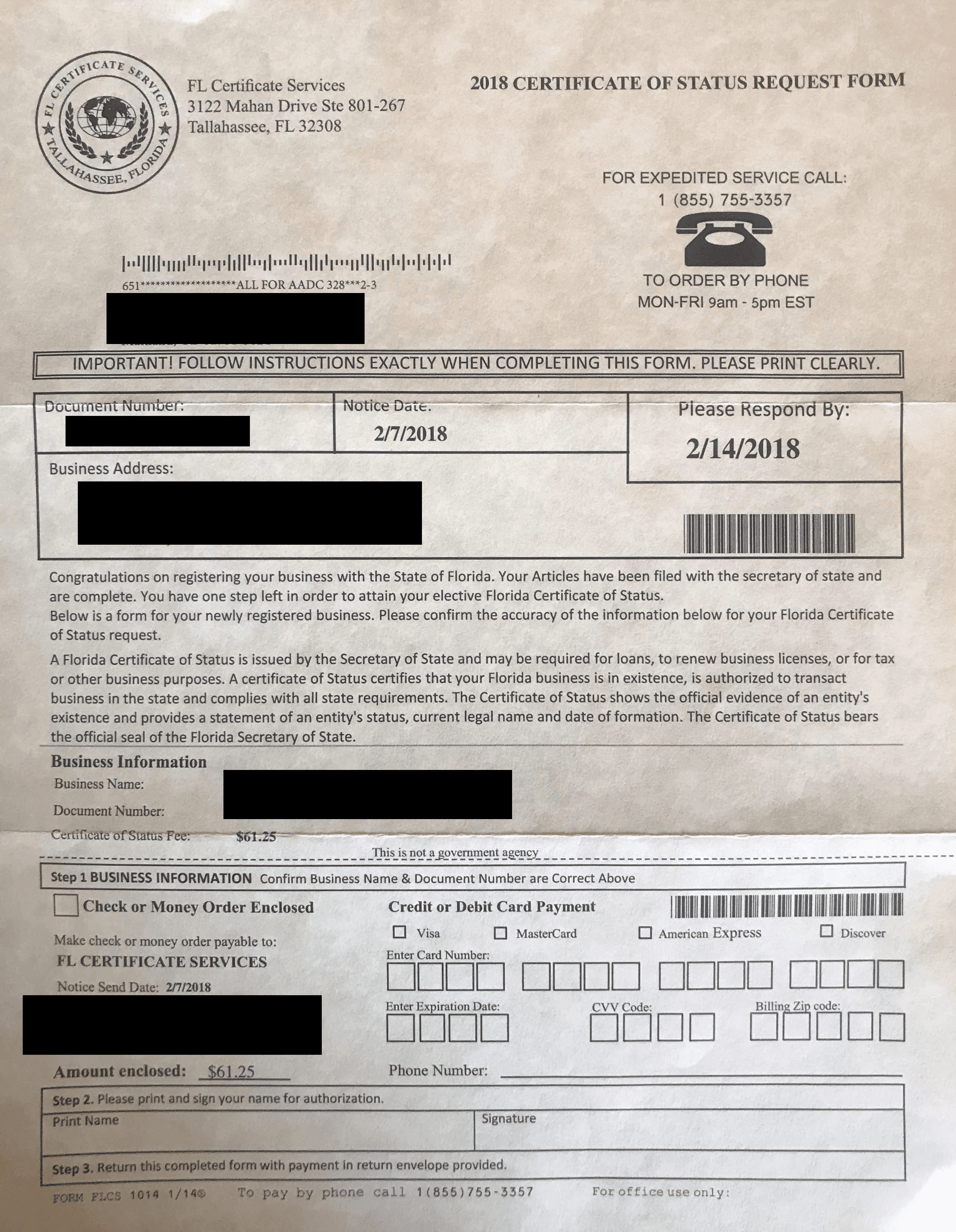
Two optional fees appear on the Division of Corporations fee schedule that most first-time filers skip at checkout: a $30.00 certified copy of the registration and a $10.00 certificate of status. Both are technically discretionary at the state level. In practice, banks routinely require one or both before opening a business checking account, and vendors increasingly ask for proof of active registration before signing contracts. Ordering them at the time of initial filing costs the same as ordering them later, but saves a second login and a separate transaction.
4. Renewal and Re-Registration Cost - Both Priced at $50.00

Renewing before expiration costs $50.00, the same flat fee as the original registration (Florida Department of State, Division of Corporations (Sunbiz)). Re-registering after a lapse also costs $50.00, so there is no financial penalty for missing the deadline beyond the administrative reset and the window of vulnerability during which someone else could file the name first. The Division of Corporations applies the same fee structure to cancellations as well, making that same figure the universal transaction cost across every lifecycle event for a Florida fictitious name (Florida Department of State, Division of Corporations (Sunbiz)).
5. Florida Department of State / Division of Corporations via Sunbiz - The Sole Official Filing Authority

The Florida Department of State, Division of Corporations administers the Fictitious Name Act under Florida Statutes section that same figure, and Sunbiz is its official filing portal. No third-party service has authority to register, renew, or certify a Florida fictitious name; they act as intermediaries who submit on your behalf, typically at a markup. Filing directly through Sunbiz at the fees listed above is both the lowest-cost path and the only channel where you receive confirmation directly from the issuing authority, with no intermediary holding your documentation.
How to File a Florida Fictitious Name Online Through Sunbiz
Filing a Florida fictitious name registration online takes about ten minutes from start to confirmation, but the portal's smooth checkout is exactly what fools most first-time filers into thinking they're done.
"I'm confused about the three-month hold period on a dissolved LLC's name in Florida and when I can register that same name as a fictitious name (DBA) through Sunbiz."
— what we hear from Florida business buyers
1. Sunbiz E-Filing Portal - Florida's Official Online Registration Hub
The Florida Division of Corporations operates Sunbiz as the state's official business entity index and the primary channel for fictitious name filings. Online submission processes far faster than mailing a paper form, which can take several weeks, a pattern consistent with what most filers report across the state. For anyone who needs their registration active quickly, the e-filing portal at efile.sunbiz.org is the only practical path. The tradeoff: its seamless design never flags the publication step that Florida law still requires after you submit.
One friction point that catches first-time filers off guard is workflow clarity. Filing a fictitious name for a Florida LLC through Sunbiz follows a different path than registering a standalone DBA, and the portal's interface does not make that distinction intuitive. If you approach the form without knowing exactly which entity type you're working with, it's easy to start down the wrong track entirely.
There's a privacy dimension worth knowing, too. The Sunbiz fictitious name application requires the owner to personally sign the final certification page, and that signature page becomes part of the publicly visible record. For business owners who deliberately structured their entity to keep their personal name off public filings, this requirement directly undermines that goal. It's not a workaround Sunbiz offers a fix for; it's a statutory design that filers in privacy-focused structures need to plan around before they start, not after.
2. Name Availability Search - Check Before You File

Before completing a single form field, run a fictitious name search on Sunbiz to confirm your intended name is not already registered by another business. The Florida Division of Corporations maintains a searchable index by owner name or fictitious name, and submitting a name that conflicts with an existing registration is one of the most common reasons filings are rejected or delayed. Skipping this step costs you the $50 non-refundable fee with nothing to show for it.
A related timing trap surfaces when a business buyer wants to register the same name previously held by a dissolved Florida LLC. The Florida Division of Corporations enforces a hold period on a dissolved LLC's name before it becomes available. That window creates real uncertainty: filers frequently don't know whether the clock on a dissolved entity has run, which can stall a business launch or force a name pivot at the worst possible moment. Check the dissolution date in the Sunbiz index before you build a brand around a name you can't yet legally register.
3. Online Application and $50 Filing Fee - Completing the Sunbiz Form

The application collects your proposed fictitious name, the owner's legal name and address, and the Florida county where the business operates. Once the form is complete, you pay the $50 non-refundable filing fee, set by the Florida Division of Corporations (2026), by Visa, MasterCard, American Express, or Discover, processed through NIC Services, LLC dba Tyler Payment Services. A payment confirmation arrives by email from noreply@finit.tylertech.com, and the name "NIC DOS DIVISION OF CORP" appears on your billing statement. The portal accepts Chrome, Firefox, Safari, and Opera, along with other HTML5-compatible browsers.
4. Mail-In Filing Option - Paper Application for Non-Online Filers

A paper application remains available for filers who cannot or prefer not to use the online portal, but processing time stretches to several weeks compared to near-immediate online confirmation, a gap that holds true across the broader market for paper-based government filings. The $50 fee is identical either way. For time-sensitive business launches, mail-in filing introduces meaningful scheduling risk, particularly if a county publication deadline is also in play.
5. Division of Corporations Processing and Confirmation - What Happens After You Submit

After online submission, the Florida Division of Corporations records the filing and publishes processing dates on the Sunbiz site so filers can track turnaround. You receive an emailed confirmation, and your fictitious name appears in the public index. Here is the structural problem: the portal treats that confirmation as a finish line. It is not. Florida law requires a separate newspaper publication of your intent to register, and Sunbiz never prompts you about it.
That gap is where most filers stall, suddenly needing to identify a qualifying newspaper for their county, submit notice text, and secure a notarized affidavit of publication. For individual filers, that's a manual hunt through county newspaper lists and phone calls to editorial departments. For attorneys, registered agents, or business formation services handling multiple clients across Florida counties, doing that work manually for every filing is the kind of operational drag that scales badly and introduces compliance gaps.
Column's self-serve portal picks up exactly where Sunbiz leaves off: filers see only newspapers that meet Florida's legal requirements for their county, submit notice text independently online without a phone call, and receive automated affidavits of publication as documented proof once the notice runs, the kind of systematic, timely proof-of-publication documentation that compliance records and court filings require.
For high-volume filers managing notices across multiple counties or states, Column Reps handle legals inbox management, notice intake and entry, order review and confirmation, customer edits and questions, invoice creation and payment follow-up, and advertiser support on behalf of the newspaper. Each Column Rep places upwards of 50 notices per day.
Getting your Sunbiz confirmation is a real milestone, but it does not make your registration legally complete. The step most filers don't see coming is next: a mandatory newspaper publication requirement that introduces both a cost variable and a process that has tripped up even experienced business owners.
The Newspaper Publication Requirement Most Florida Filers Miss

Florida's Statutory Publication Requirement
Newspaper publication is legally required for Florida fictitious name registration. Under Florida Statutes s. 865.09, registrants must advertise their fictitious name in a newspaper as defined in Chapter 50, F.S. in the county of their principal place of business, a certification requirement embedded directly in the official filing form itself. The statute references s. 50.011 to define what a qualifying newspaper looks like, which means not every local paper makes the cut. The requirement has been on the books since at least July 2009, when Florida Statutes s. 865.09 codified the pre-filing publication obligation in its current form.
Why Publication Costs Vary and Where Filers Get Stuck
Second: the affidavit. Florida Statutes s. 865.09 requires the registrant to obtain and retain a proof-of-publication affidavit as legal evidence that the advertisement requirement was fulfilled, and obtaining it typically means contacting the newspaper's classifieds desk and waiting. Filers worry whether the affidavit will arrive, in what format, and whether it will hold up if a court, landlord, or bank asks for documentation.
Column's self-serve portal addresses both friction points directly. Once placement is complete, Column's Automated Affidavits feature delivers the proof-of-publication affidavit digitally, without a single phone call to a classifieds desk. For filers who need notices to be searchable and accessible after publication, Column's Digital Public Notice Search Site ensures those records are findable online, particularly valuable as legislative and regulatory expectations around digital accessibility continue to evolve.
Related Reading
Fictitious Business Name Statement Example
How To File A Fictitious Business Name In California
How To Register A Fictitious Business Name In Pa
Do I Need A Fictitious Business Name In Florida
How To Register A Fictitious Business Name In Florida
How Column's Self-Serve Portal Handles Publication and Your Affidavit in One Place
The proof-of-publication affidavit is the legal artifact that actually closes a Florida fictitious name registration, yet it lives entirely outside Sunbiz, must come directly from a qualifying county newspaper, and has no official state guide explaining how to get it.

Why "Just Call the Newspaper" Breaks Down for First-Time Filers
The phrase makes the process sound simple, but it obscures several sequential requirements. A filer must first confirm the paper holds legal qualification status for their specific county, then submit notice copy in the correct format, then wait for the publication run, and then follow up to obtain a notarized proof-of-publication affidavit.
Each of those steps involves a different contact, a different timeline, and a different document. When the affidavit doesn't arrive on schedule, there's no state system to escalate to and no tracking mechanism. The process stalls quietly, and the registration sits legally incomplete while the filer assumes everything is fine. That coordination gap is where most delays actually happen, and it's the problem a structured self-serve portal is designed to eliminate.
How Column's Portal Filters to Only County-Qualifying Florida Newspapers
The single biggest source of anxiety in this step is whether you've chosen the right newspaper. Column's self-serve portal filters its newspaper options by county, displaying only publications that meet Florida's legal qualification requirements for the filer's specific location. The filer enters their county, and the portal returns only eligible options. No cross-referencing a county clerk's list, no calling a newspaper to ask whether they qualify, no risk of publishing in a paper that turns out to be ineligible. This matters most for filers in counties with multiple local papers, where the distinction between a qualifying newspaper of general circulation and a non-qualifying one is not obvious from a Google search.
From Notice Submission to Notarized Affidavit in Four Business Days
Once a filer selects a qualifying paper, Column's portal handles notice construction, scheduling, and payment in a single session, designed to minimize setup friction for first-time filers. The notarized affidavit is then delivered within four business days of the publication run completing. One honest limitation: Column's self-serve portal is built for straightforward notice types, so filers with unusually complex registration structures may need to contact a newspaper directly. With those steps complete, the next section answers the most common procedural questions that don't fit neatly into any single step, so nothing falls through the cracks before you file.
Related Reading
Delaware Llc Publication Requirement
New Jersey Llc Publication Requirement
Do You Need A Fictitious Business Name For Llc
Pennsylvania Llc Publication Requirement
What Is A Fictitious Business Name
Difference Between Fictitious Business Name And Dba
Florida Fictitious Name Registration FAQs
Florida fictitious name registration carries more nuance than most business owners expect, and the cost question rarely arrives alone. LLC owners, buyers taking over an existing business, and anyone operating under a trade name all run into structural requirements that can stall or complicate a filing if they surface mid-process rather than upfront. The FAQs below work through the scenarios most likely to catch you off guard, so you can plan the filing around the rules rather than discover them after the fact.

Does Your Florida LLC Still Need a Fictitious Name Registration
Yes, and this surprises a lot of LLC owners. According to the Florida Division of Corporations, an LLC must register a fictitious name if it operates under any name different from its exact registered legal name on file with the Division. So if your LLC is registered as "Hernandez Consulting Group LLC" but you market under "HCG Creative," that trade name requires a separate fictitious name filing under Chapter that same figure, Florida Statutes. The LLC structure itself does not cover the trade name. A common pattern among multi-layered LLC owners is assuming the entity registration handles everything, and that assumption is what creates the compliance gap.
One friction point that catches multi-layered LLC owners off guard: the Florida Fictitious Name Registration form requires a personal signature on a public-facing page. For ownership structures designed to keep personal identity a layer removed from the operating entity, that requirement is a direct conflict. It has no workaround at the state level. The signature obligation is statutory, but knowing it in advance lets you structure the filing around it rather than discovering it mid-process.
A separate anxiety surfaces during business acquisitions. Buyers frequently misread a dissolved LLC's name as being under a three-month hold, creating real concern about whether the storefront name survives the ownership transition. That concern is understandable, but the fictitious name registration and the LLC registration are separate records. The DBA can be re-registered independently of what happens to the underlying entity, which is why understanding both tracks before a transaction closes matters.
Name Availability, Payment Options, and the Mail-In Alternative Answered Directly
Check availability before you file. The Sunbiz fictitious name search tool lets you search the Division of Corporations database at no cost before you submit anything. If the name is active under another registrant, you cannot use it.
Sunbiz accepts credit cards for online filings. Filers who prefer not to use the portal can submit a paper application using form DS-DE 97, mailed directly to the Division of Corporations in Tallahassee with a check or money order for the $50 fee. The mail-in route works, but processing takes longer, and you lose the instant confirmation the online portal provides.
One honest limitation worth naming: neither the online portal nor the paper form tells you what comes next after the state accepts your filing. The newspaper publication requirement is a separate obligation that Sunbiz does not manage, and that gap is where most filers get stuck.
Beyond Legal Compliance What a Fictitious Name Actually Unlocks
The practical payoff is concrete. Banks typically require a registered fictitious name before they will open a business checking account under a trade name. Beyond banking, a registered DBA lets you sign contracts, invoice clients, and accept payments under the trade name, which matters for anyone building a brand separate from their legal name.
Florida fictitious name registrations expire every five years, and renewal triggers the same compliance obligations as the original filing, including the publication requirement. If the name lapses entirely, a competitor can register it during the gap window, and the original owner loses standing to pursue contracts made under that name. Registration is a recurring five-year obligation with real legal consequences each cycle.
That recurring cycle is also where proof-of-publication documentation becomes a compliance record, not just a formality. After a legal notice runs in a qualifying newspaper, filers need a signed affidavit of publication to demonstrate the statutory requirement was met, for the state, for lenders, and for any future legal proceeding that touches the business name. Column manages that documentation step through automated affidavits generated after publication, so filers receive proof of publication without having to chase the newspaper for paperwork. For anyone handling multiple entities or anticipating renewals across several registrations, that systematic documentation removes the follow-up burden that otherwise falls on the filer.
Once these questions are off the table, there is only one moving part left that most guides leave you to figure out alone: the newspaper publication step. The next section shows you exactly how to clear it, including cost, qualifying papers, and how to receive your public notice affidavit without the usual guesswork.
Next steps
If your Florida fictitious name filing felt complete the moment Sunbiz sent a confirmation, the path forward starts with understanding that the $50 state fee and the legal completion of your registration are two different things. The newspaper publication step, and the notarized affidavit it produces, is what actually closes the process under Florida law. Start with our public notice.
The Sunbiz portal is designed to accept payment and confirm submission without ever prompting filers about the mandatory newspaper publication requirement, which means a filer can complete every screen, receive a confirmation, and still be legally barred from suing in Florida courts under that name. That structural gap makes the affidavit of publication, not the Sunbiz receipt, the document that actually matters. Together, those two facts point to finishing the publication step in the same session as your state filing, not days later after a round of calls to newspaper classifieds departments.
Start with public notice through Column's self-serve portal, which filters to only county-qualifying Florida newspapers, handles notice submission without an account, and delivers your notarized affidavit digitally within four business days of publication. Once that affidavit is in hand, your registration is legally complete and documented.
Frequently Asked Questions
Do I have to publish my fictitious name in a newspaper before I file with the state?
Florida law requires you to advertise your fictitious name at least once in a newspaper of general circulation in the county where your principal place of business is located, either before or after filing with the state, so publication can happen on either side of the Sunbiz filing. What it cannot do is be skipped entirely; the registration is legally incomplete without it, regardless of what the Sunbiz confirmation screen implies.
How do I check if my business name is already taken in Florida before I file?
Run a fictitious name search on Sunbiz before you fill out a single form field, the Florida Division of Corporations maintains a searchable index by owner name or fictitious name. Submitting a name that conflicts with an existing registration is one of the most common reasons filings are rejected or delayed, and since the $50 fee is non-refundable, skipping the search can cost you money with nothing to show for it.
How long does it take for a Florida fictitious name registration to go through?
Online filing through the Sunbiz e-filing portal processes far faster than mailing a paper form, which can take several weeks. For anyone who needs their registration active quickly, the e-filing portal is the only practical path.
When does my Florida fictitious name registration expire, and what does it cost to renew?
A Florida fictitious name registration is valid for five years and expires on December 31 of the fifth year following registration, regardless of what month you originally filed. Renewing before expiration costs $50, the same flat fee as the original registration, and the Florida Department of State will mail a renewal reminder to your last reported address at least three months before the expiration date.
Does my LLC need a separate fictitious name registration if it operates under a different brand name?
Yes, the moment an LLC operates under any name that differs from its registered legal entity name, it must file a separate fictitious name registration. For example, an LLC incorporated as "Bright Future Services LLC" that answers phones as "Sunshine Cleaning Co." needs its own fictitious name filing; the entity registration and the DBA filing are two distinct legal obligations.